
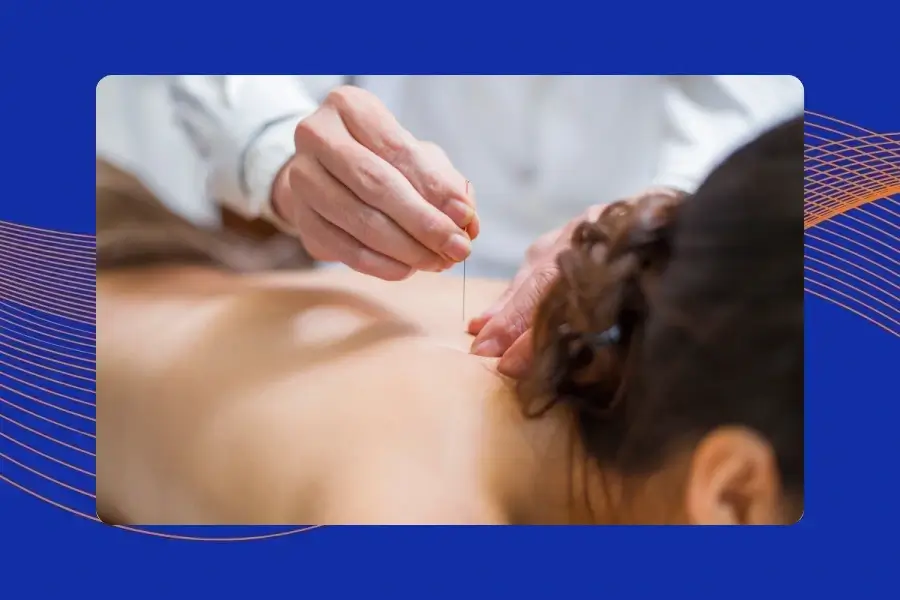
A staple of traditional Chinese medicine (TCM), acupuncture or “needling” has been used to treat back pain for over 2000 years.
Needless to say, 2000 years ago, our concept of biology was in its earliest stages. The ancients had yet to invent technologies, like microscopes, that would enable them to study diseases. But, they understood that something vital must exist beneath the surface. In other words, they knew that there were forces that could make you sick and practices that could promote healing.
This knowledge gave birth to the notion of Qi or “the life force.” The ancients believed that Qi (sometimes spelled “chi”) flowed through pressure points on the body. These acupuncture points synced up to form 12 meridians, or paths of energy much like the lines on a map.
If any one of these pathways became blocked, then the ancients believed that you would become sick. At its outset, acupuncture sought to restore the flow of Qi by using needles to redirect and open up energy flow. Today, acupuncture is also used as a complementary, non surgical option for some people with ongoing or chronic back pain. While research is still exploring exactly how it works, treatment may influence the nervous system and the way the body processes pain.
How Does Acupuncture Treatment Relieve Chronic Back Pain?
Have you ever heard of a “tattoo high”? This occurs when a person who receives a tattoo feels a rush of euphoria mid-way through their tattooing session.
Although much less intense than receiving a tattoo, the pain release from acupuncture is thought to work in much the same way.
During an acupuncture session, a licensed acupuncturist will insert between 4 – 30 needles into your back. Yet, on average, 6 – 8 will do the trick. The depth of the needle will be tailored to fit your condition. For example, deep tissue injuries, like muscle strains and sprains, will call for deeper needle access than surface injuries.
After about 20 minutes, your acupuncturist will remove these thin needles and insert more. But, it’s what happens next, in the middle of your 1-hour session, that’s interesting.
As your body adapts to mild pain, your nervous system (including your brain and spinal cord) kick into high gear. (In fact, some people believe that using acupressure points can turbo charge this process in ways that inserting needles into random areas simply couldn’t.)
As the minutes tick by, your body responds by releasing endorphins, the body’s natural form of opioids or pain-relievers. Endorphins (which also give rise to the “Runner’s High” and “Tattoo Europhia”) work to dampen neck and back pain. Simultaneously, acupuncture fires up the hypothalamus and pituitary gland. These structures labor to create even more chemicals that blunt how we experience pain.
In addition to needling, your acupuncturist may also use the following therapies to jump start your pain relief:
- Electrotherapy, or running a weak current through the needle to relax the muscles
- Cupping, or using suction cups to increase the flow of blood to key areas
- Moxibustion, or using an herb to warm up the needle
Results differ from person to person. The source of the pain, the length of time you have had it, and whether a nerve is involved can all affect how much relief you notice.
How Long Does It Take for Acupuncture to Relieve Back Pain?
Some people feel looser or experience short term pain relief after an initial appointment. Others do not notice a clear change until they have attended several sessions. There is no single timeline that applies to every type of back pain.
For example, someone with back tightness after a recent muscle strain may notice that they move more comfortably after a few treatments. Someone with leg pain, numbness, or weakness caused by nerve compression may need a broader assessment and may not improve with acupuncture alone.
The most useful measure is not simply whether pain disappears after one appointment. Look for practical changes. Can you stand longer? Sleep more comfortably? Walk farther? Get through a workday with fewer breaks? These small gains can help show whether the treatment is worthwhile.
If symptoms remain unchanged after a reasonable course of care, or if they continue to limit daily life, it is worth speaking with a doctor or spine specialist about other options.
Harnessing the Benefits of Acupuncture Therapy
If you have been living with chronic back pain for quite some time, then you are probably more than ready to explore new paths to relief. Consider these potential benefits of acupuncture:
Going Medication Free
Most people don’t get jazzed up about the idea of putting unnatural chemicals into their bodies. And, for good reason. Although effective, pain medications like Vicodin can lead to addiction. Even milder drugs, such as ibuprofen, can cause nasty side effects, like stomach ulcers. As a form of “alternative” medicine, acupuncture doesn’t rely on the use of drugs to treat your pain. This means that you can achieve pain relief by making the most of your body’s natural, addiction-free analgesics.
For people who cannot take certain medications, prefer to limit their use, or want to combine non drug options with a wider treatment plan, acupuncture may be worth discussing with a certified acupuncturist and your spine care team.
Pain Relief
In 1998, the National Institutes of Health (NIH) stated that needling could be used to ease nausea, especially in cancer patients. Since then, studies have also shown that acupuncture can be used to relieve:
- Neck, knee, or low back pain
- Headaches
- Muscle strains or sprains
- Myofascial pain
- Osteoarthritis, or joint pain from wear and tear
- Sciatica, or leg and low back pain
For back pain in particular, acupuncture may be more helpful when it is paired with other appropriate care, such as a guided exercise plan or physical therapy.
Mood
Like yoga or meditation, needling urges the patient to relax and can relieve stress. People who use acupuncture report lower levels of depression, anxiety, and insomnia. In fact, studies show that people who use needling also have lower blood pressure.
For some people, the quiet setting and focused treatment time are part of the appeal. Chronic pain can make sleep, stress, and mood harder to manage, so even a small sense of relief can matter.
An Immune System Boost
High stress levels are often linked to illness. But, it’s an equally well-known fact that relaxation can give the body a natural immune boost. When we feel energized, our bodies can fight diseases more effectively. (And, we just tend to feel better in general.)
It is more accurate to view acupuncture as a possible supportive therapy for pain and relaxation, rather than a replacement for medical care.
Finding Out What Works For You
Acupuncture isn’t the only form of alternative therapy. Just as the thought of taking medicine doesn’t excite many patients, equal numbers of people feel skittish around needles. If needling doesn’t sound right for you, keep in mind that you can try other forms of gentle treatment for back pain. Other effective therapies include:
- Physical therapy with exercises tailored to your movement limits
- Chiropractic Care
- Yoga or gentle mobility work when cleared by your clinician
- Pilates
- Tai Chi
- Massage Therapy
- Aromatherapy
- … and many more!
Start with the option that best matches the reason for your pain and is approved by your spine care team. If tight muscles and reduced mobility are the main problem, targeted rehabilitation may be a sensible first priority. If pain travels into the leg, causes numbness, or makes walking difficult, it is worth getting a medical assessment rather than continuing to cycle through treatments on your own.
Acupuncture may not be working well enough if you have completed several appointments without meaningful improvement in pain, mobility, sleep, or day to day function. It may also be time for further assessment if relief only lasts a few hours, symptoms return more intensely, or you need to avoid more activities each week.
Surgery is not always the immediate next step for someone with acute or chronic back pain. It may be considered when non surgical treatment has not provided enough relief, symptoms are significantly limiting daily life, or there are signs of progressive nerve compression, weakness, instability, or spinal cord involvement. A spine specialist near you can help determine whether imaging, further non surgical care, or a surgical discussion makes sense for your situation.
If you have tried acupuncture or other conservative options and are still struggling with back or leg symptoms, our team at The Advanced Spine Center in New Jersey can help you work out what may be causing the problem and what to consider next. Request an appointment today to get started.
Updated Aug 26, 2026.