
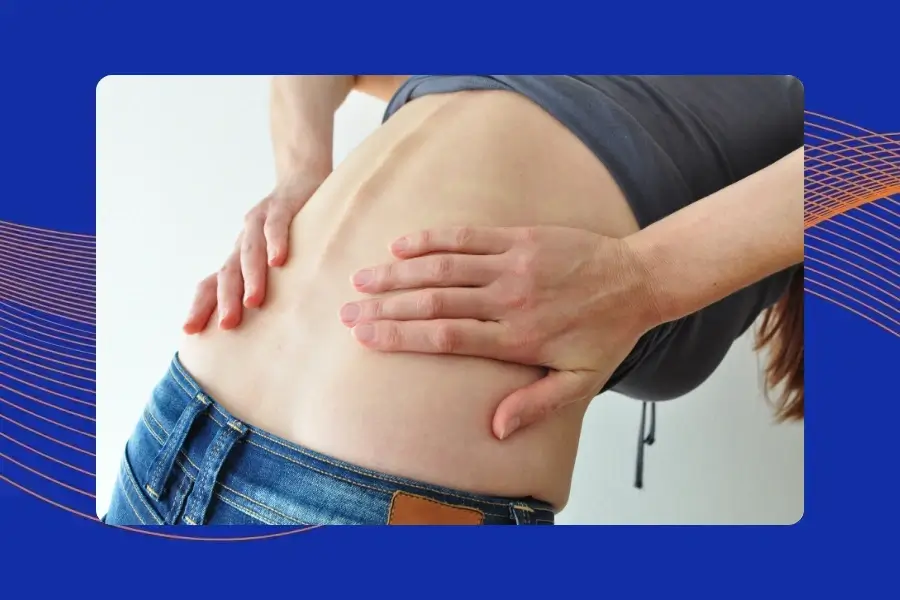
It is common for adults to attribute ongoing back pain, stiffness, or gradual posture changes to the natural aging process. While age does affect the spine, certain symptoms should not be ignored: a noticeable lean to one side, uneven shoulders or hips, difficulty standing or walking, back pain when upright, leg pain or numbness, and declining endurance.
Discover how to distinguish normal age-related discomfort from symptoms of degenerative scoliosis and when evaluation by a spine specialist may be appropriate. At The Advanced Spine Center, patients receive careful, evidence-based evaluation to clarify their condition and explore appropriate treatment options.
What Is Degenerative Scoliosis?
Degenerative scoliosis is an adult-onset spinal condition in which the spine develops a sideways curve due to age-related structural changes. Unlike scoliosis that begins in childhood or adolescence, it develops later in life as discs degenerate, joints become arthritic, and spinal stability decreases, often with subtle early symptoms.
To understand what degenerative scoliosis is, it helps to note the difference between degenerative scoliosis and other types of scoliosis. Idiopathic scoliosis typically appears in adolescence without a clear cause, while congenital scoliosis is present at birth. Degenerative scoliosis develops after years of normal alignment and is driven by long-term wear and tear, which often affects symptoms and treatment decisions.
The condition is most commonly seen in adults over 50. For those asking at what age degenerative scoliosis occurs, there is no fixed age, but risk increases as discs and joints lose resilience. So what causes degenerative scoliosis? Disc height loss, facet joint arthritis, and spinal instability create uneven loading, leading to progressive curvature and, in some cases, pain or neurologic symptoms.
Early Signs of Degenerative Scoliosis
Postural Changes and the “Lean”
One of the earliest and most commonly overlooked signs of degenerative scoliosis is a gradual postural shift, sometimes referred to as “the lean.” Patients may begin to notice subtle alignment changes, including:
- The torso no longer appearing centered over the pelvis
- One hip or shoulder sitting higher than the other
This asymmetry develops as the spinal curve alters alignment and weight distribution and can occur well before significant pain is present.
The “Shopping Cart Sign” and Standing Pain
Another early indicator is the so-called “shopping cart sign.” Many individuals find that leaning forward on a grocery cart, countertop, or walker provides noticeable relief from lower back or leg discomfort. This forward-flexed posture can temporarily reduce pressure on compressed nerves and is often associated with spinal stenosis that develops alongside the scoliotic curve.
For patients wondering whether degenerative scoliosis can cause back pain when standing or walking, this pattern of relief with forward bending is a key clinical clue that spinal narrowing may be contributing to symptoms.
Changes in Gait and Balance
As degenerative scoliosis progresses, changes in gait and balance may become noticeable. As the spinal curve shifts the body’s center of gravity, walking can begin to feel less stable. Patients commonly describe:
- Feeling unsteady or off-balance
- Walking more cautiously than usual
- A sense of being unusually “clumsy,” particularly on uneven surfaces or during longer walks
These changes reflect how degenerative scoliosis affects mobility by altering the mechanics of standing and movement.
One-Sided Leg Symptoms
Unilateral leg symptoms are another important warning sign. Pain, numbness, tingling, or a feeling of heaviness that consistently affects one leg more than the other can occur when the spinal curve compresses specific nerve roots.
Unlike generalized muscle soreness, these symptoms often:
- Worsen with prolonged standing or walking
- Improve with sitting or bending forward
This pattern frequently points to nerve compression related to the spinal deformity and should prompt further medical evaluation.
Many patients also experience a gradual loss of endurance. Activities like standing for brief conversations, walking through a store, or completing routine tasks may become difficult due to aching in the lower back or hips. This reduced tolerance for standing or walking is a common but often overlooked sign of degenerative scoliosis and may indicate the condition is progressing and should be evaluated by a spine specialist.
Is Degenerative Scoliosis Serious?
When Degenerative Scoliosis Becomes Serious
Patients often ask whether degenerative scoliosis is serious, particularly when symptoms begin to affect daily life. The condition can become serious when spinal degeneration leads to nerve compression, worsening pain, or reduced mobility. While some individuals live for years with mild curvature, others experience progression that affects balance, function, and independence. Recognizing when symptoms extend beyond routine age-related back pain is essential.
Degenerative scoliosis is more likely to require medical attention when it leads to:
- Persistent or worsening back pain
- Nerve-related symptoms in the legs
- Reduced mobility or balance
- Increasing difficulty with daily activities
Does Degenerative Scoliosis Get Worse Over Time?
A common concern is whether degenerative scoliosis gets worse over time. In many cases, it does progress as discs and joints continue to degenerate. As the curve advances, spinal stability may decrease, increasing the risk of nerve irritation or spinal stenosis. Progression is not always predictable and may occur gradually or accelerate after long periods of stability.
Warning signs of degenerative scoliosis that should not be ignored include:
- Increasing pain despite physical therapy, medications, or injections
- Leg pain, numbness, tingling, or weakness
- Difficulty standing upright or walking longer distances
- Rapid or noticeable changes in posture or balance
These symptoms often indicate advancing structural or nerve involvement.
When to See a Spine Specialist for Degenerative Scoliosis
When symptoms begin to affect quality of life or independence, evaluation by a spine specialist is appropriate. Indicators include persistent pain, progressive neurological symptoms, and difficulty performing routine activities such as walking through a store, standing to prepare meals, or maintaining balance.
It is also important to address whether degenerative scoliosis can be reversed. Structural curvature caused by degeneration typically cannot be reversed, but symptoms can often be managed, slowed, or stabilized with appropriate care. A surgical consultation does not mean surgery is inevitable—it provides clarity on condition severity, stability, and available treatment options.
How Degenerative Scoliosis Is Diagnosed and Measured
Diagnosing degenerative scoliosis involves more than identifying a spinal curve on imaging. A complete evaluation considers spinal alignment, curve stability, and possible nerve involvement. Understanding how degenerative scoliosis is diagnosed requires combining clinical findings with imaging to assess both the presence of scoliosis and its impact on daily function.
Physical Exam and Symptom Review
Evaluation begins with a detailed physical examination and symptom discussion. A spine specialist will assess posture, balance, and mobility, along with a review of symptoms such as:
- Location and pattern of back pain
- Leg pain, numbness, or weakness
- Reduced endurance with standing or walking
Changes in daily activities or function
This step helps determine whether symptoms are mechanical, nerve-related, or both—an important distinction in adult scoliosis.
Imaging Studies Used to Diagnose Degenerative Scoliosis
Imaging plays a central role in confirming diagnosis and severity. Common studies include:
- Standing X-rays, used to visualize the curve, assess alignment, and monitor changes over time
MRI scans, often ordered when leg symptoms are present, to evaluate discs, nerves, and spinal stenosis
Together, these studies clarify both structural and neurologic components of the condition.
How Doctors Measure the Severity of Degenerative Scoliosis
Physicians use standardized measurements to evaluate curve severity and progression, including:
- Cobb angle measurements to quantify curvature
- Assessment of spinal balance across the head, spine, and pelvis
- Evaluation of instability that may contribute to symptoms
These findings guide decisions about monitoring, conservative care, or advanced treatment options.
Why a Comprehensive Evaluation Matters
A comprehensive approach allows spine specialists to assess progression risk and tailor treatment to the individual, ensuring decisions are based on the full clinical picture—not curve size alone.
Taking the Next Step In Degenerative Scoliosis Care
Uncertainty about back pain, posture changes, or declining mobility can be as difficult as the symptoms themselves. The good news is that degenerative scoliosis is often manageable, especially when it is identified early and evaluated carefully. A clear diagnosis helps replace uncertainty with direction and makes treatment decisions easier to navigate.
A proactive evaluation allows a spine specialist to assess whether symptoms are likely to progress and which treatment options may help preserve function and independence. At The Advanced Spine Center, patients receive thoughtful evaluation, education, and access to appropriate care, whether that means monitoring, non-surgical treatment, or discussing surgical options. Taking this step can bring clarity, confidence, and greater control over your spinal health.