
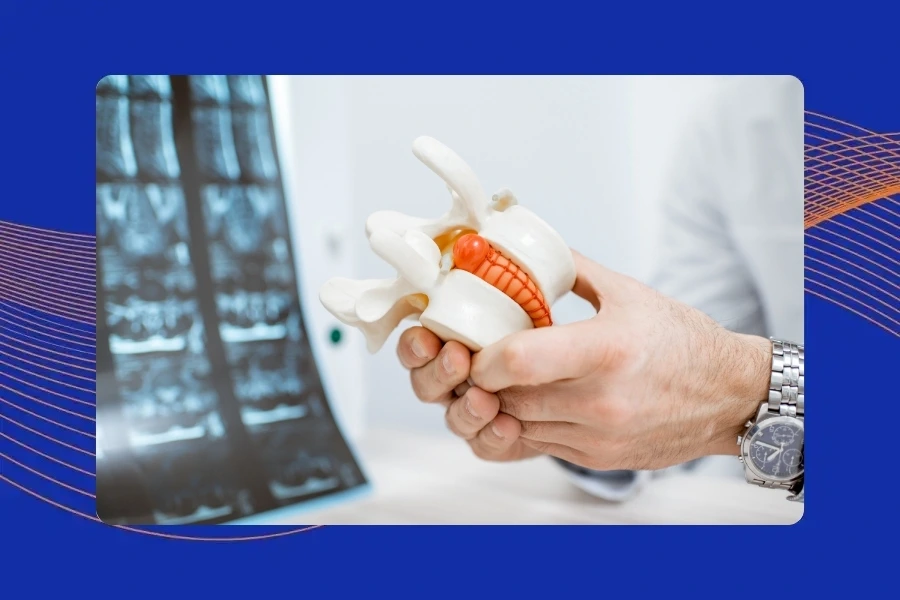
A lot of patients arrive at the artificial disc replacement conversation knowing very little about it. Getting here usually takes a while. Failed injections, rounds of physical therapy, maybe a second opinion or two. At some point the conversation shifts from managing the pain to addressing the source of it, and artificial disc replacement enters the picture. If you’re doing your research before that next appointment, you’re in the right place.
We tend to fall into the same categories: what the surgery actually involves, what recovery looks like, and whether the risks are worth it. Find out our answers to the top 7 most common questions about ADR.
1. Will Artificial Disc Replacement Relieve My Nerve Pain?
For many patients, the disc itself isn’t the only problem. When a disc deteriorates or herniates, it can press on nearby nerves and send pain, numbness, or weakness shooting into the arms or legs. Removing the damaged disc takes that pressure off.
Most patients see significant improvement in nerve-related symptoms after surgery. The artificial disc replacement success rate for radicular pain relief is generally high, particularly when nerve compression hasn’t been present for an extended period. The longer a nerve has been compressed, the more time it may need to recover, and in some cases symptoms don’t fully resolve.
2. How Long Does Artificial Disc Replacement Surgery Take?
Most cases take between 1 -2 hours. The variation comes down to which level is being treated and the complexity of your anatomy.
One thing patients don’t always anticipate is the approach. ADR is performed from the front of the body rather than the back. Reaching the disc requires carefully moving abdominal structures and major blood vessels out of the way, which adds time to the setup before the disc work begins. Experienced spine surgeons who perform Artificial Disc Replacements regularly move through that process efficiently.
3. How Long Do Artificial Discs Last?
Modern implants are built to last 20 or more years, and long-term data backs that up. Studies following patients a decade and beyond show high rates of sustained pain relief, preserved motion, and patient satisfaction.
A common follow-up is whether the implant ever needs to be replaced. Revision surgery is uncommon but possible, typically in cases where the implant shifts or the surrounding bone changes significantly over time. For the vast majority of patients, artificial disc replacement is a long-term solution, not a temporary one.
4. What Are the Risks of Artificial Disc Replacement?
Every surgery carries risk, and ADR is no exception. The most common artificial disc replacement complications include:
- Infection at the surgical site
- Implant positioning issues requiring revision
- Nerve irritation during or after surgery
- Adjacent segment stress over time
The other side of the risk conversation is what happens without surgery. For patients whose conservative treatment has already failed, continued disc degeneration, worsening nerve compression, and chronic pain are the realistic alternatives. Artificial disc replacement risks are best evaluated when looking at the whole picture.
5. How Does Artificial Disc Replacement Compare to Spinal Fusion?
ADR replaces the disc with an implant that continues to move. Spinal fusion removes the disc and locks the vertebrae above and below into a fixed position. Both procedures can resolve pain effectively in the right patient. The difference is what happens at and around the treated level over time.
Preserved motion in ADR reduces stress on neighboring discs, which lowers the long-term risk of adjacent segment disease. Fusion transfers that load to surrounding levels by eliminating motion entirely. For patients with spinal instability, significant deformity, or multi-level involvement, artificial disc replacement vs spinal fusion often tips toward fusion because a motion-preserving implant cannot adequately address those structural demands. For single-level disc disease without instability, ADR is often the better choice over fusion, since preserving motion becomes increasingly important over decades.
6. Can You Have Disc Replacement at More Than One Level?
Single-level replacement is the most common scenario and the case for which ADR is most extensively studied. Multi-level artificial disc replacement is performed in carefully selected patients, but it requires a more detailed evaluation of how each affected level is contributing to symptoms.
If your imaging shows involvement at more than one level, that doesn’t automatically mean ADR is off the table. It means your ADR spine surgeon needs to determine whether each level is symptomatic, structurally suitable for an implant, and whether multi-level replacement is the right approach for your specific anatomy. The artificial disc replacement success rate at multiple levels depends heavily on patient selection.
7. Will I Be Able to Return to an Active Lifestyle After Disc Replacement?
For most patients, yes. Walking begins within hours of surgery and desk work is typically possible within 2-4 weeks. By the 6-week mark, most patients are moving more freely and managing daily activity without significant restriction. After 3 months, many are back to exercise, travel, and the physical parts of their lives that chronic pain had sidelined.
The motion-preserving design of ADR supports an active life in a way fusion doesn’t always allow. Fusion patients often find certain movements permanently limited at the treated level. ADR patients generally retain the flexibility to bend, twist, and move through a fuller range of motion as they heal. Every recovery is individual, and your surgeon can give you a realistic picture based on your specific case.
Talk to a Spine Surgeon at The Advanced Spine Center
Research gets you prepared and a consultation gets you answers specific to your spine, your imaging, and your history. The fellowship-trained spine surgeons at The Advanced Spine Center in New Jersey review each case individually before making any recommendation.
Schedule a consultation to bring your artificial disc replacement questions directly to a specialist.