
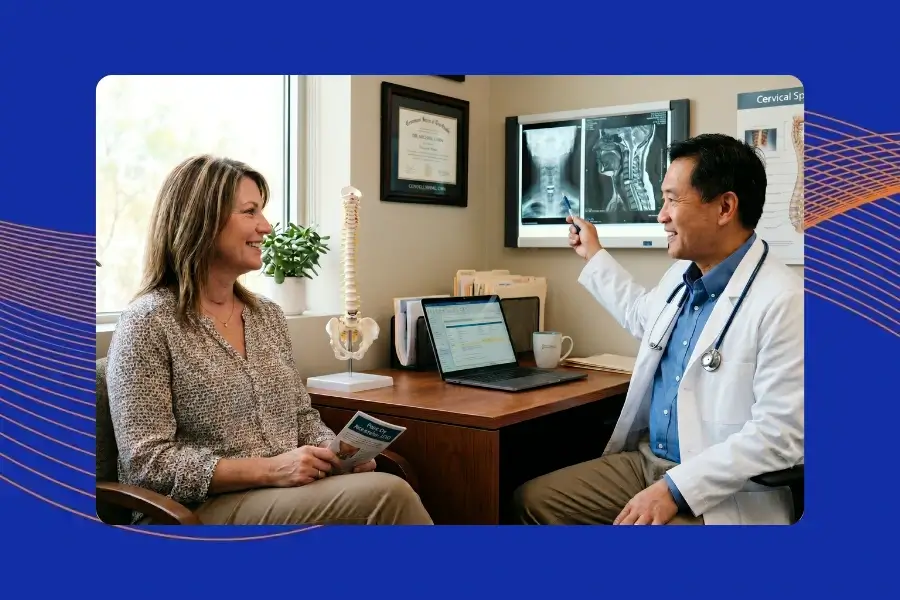
Most patients scheduled for artificial disc replacement ask the same question before their procedure: “When can I get back to my life?” The answer is faster than most people expect. Most patients return to light activity and desk work within 1-2 weeks. Full recovery typically happens by 3 months.
Dr. George S. Naseef, board-certified fellowship-trained disc replacement specialist at The Advanced Spine Center in New Jerseys, breaks down what an ADR recovery actually looks like.
Week-by-Week Artificial Disc Replacement Recovery Timeline
Week 1: Home and Wound Care for Artificial Disc Replacement Recovery
The first week is about rest, wound care, and managing discomfort.
You will need to change your dressing as instructed by your spine surgeon. By day 2, the wound can typically be left uncovered, but avoid submersion in water, pools, or hot tubs for 2-3 weeks. Keep the incision site clean and dry and watch for any signs of infection.
Pain is usually mild to moderate. Most patients transition from prescription pain medication to over-the-counter options like acetaminophen or ibuprofen within the first week. If you had cervical disc replacement, you typically will no longer need a collar.
Weeks 2 to 4: First Follow-Up and Getting Moving Again
Your first follow-up appointment is usually scheduled for week 1 or 2. This is a normal part of artificial disc replacement recovery timeline so it’s important to not put this off. At your follow-up, your spine surgeon will examine the wound, confirm healing progress, and in some cases take X-rays to check disc placement. Any sutures or steri-strips are typically removed around the 10 to 14 day mark.
This is also when artificial disc replacement surgery recovery time starts to feel more manageable for most patients. Activity picks up:
- Driving is typically cleared around week 2 to 3 once you are off opioid medications and can move comfortably.
- Lifting up to 25 pounds is generally cleared around week 3.
- Returning to work after disc replacement for desk workers typically occurs around week 4. Physically demanding jobs take longer, pending your spine surgeons clearance.
- Physical therapy usually begins at week 4.
Weeks 4 to 12: Physical Therapy and Rebuilding Strength Post ADR
Even though ADR preserves spinal motion, the surrounding muscles and soft tissues need reconditioning. Physical therapy after disc replacement is how that happens.
Most patients complete 1-2 post-ADR physical therapy sessions per week over 4-8 weeks, depending on progress. For cervical disc replacement patients, the focus is on neck mobility, posture, and upper body strength. For lumbar patients, the emphasis is on core stabilization, hip mobility, and a gradual return to cardio.
3 Months and Beyond: Full Activity for Artificial Disc Replacement Recovery
Most patients reach full activity by the 3-month mark. This is when your surgeon will review imaging and clear you for the things that brought you to this surgery in the first place. When can you play golf, hike, or exercise after disc replacement? For most patients, the answer is right around this ADR recovery milestone.
Follow-up appointments continue at 6 months and 1 year post-artificial disc replacement surgery, then every 1-2 years ongoing.
How Recovery Differs for Cervical vs. Lumbar Artificial Disc Replacement
Motion preserving cervical disc replacement recovery and lumbar total disc replacement recovery follow similar paths but are not identical:
| ADR Recovery Milestone | Cervical Disc Replacement Recovery | Lumbar Disc Replacement Recovery |
| Hospital stay | Same-day or 24-hour | Same-day outpatient |
| Return to desk work | Weeks 1 to 2 | Weeks 2 to 3 |
| Drive again | Weeks 2 to 3 | Week 3 |
| Physical therapy start | Week 4 | Weeks 4 to 6 |
| Full activity | 6 to 12 weeks | 8 to 12 weeks |
| Return to sport | 3 months | 3 months |
The main difference in early cervical disc replacement recovery and early lumbar total disc replacement recovery comes down to where the soreness is. Cervical patients may notice some throat discomfort for the first few days. Lumbar patients tend to have more abdominal soreness early on, which is why cervical artificial disc replacement recovery time tends to move a little faster in the first few weeks. Both procedures get to the same place by month 3 in most cases.
Factors That Affect Your ADR Recovery Timeline
No two recoveries look exactly the same. The number of levels treated makes a difference. Two-level artificial disc replacement surgery recovery time is slightly longer than single-level. How long a nerve was compressed before surgery also matters, since nerves that have been under pressure for an extended period take more time to recover even after the source is removed.
Age, baseline fitness, and commitment to physical therapy all play a role. Patients who stay consistent with their PT program recover more fully and more quickly. Smoking impairs tissue healing and should be stopped well before surgery.
Spine surgeon experience is one of the most significant factors in artificial disc replacement recovery. Less tissue disruption during surgery means less post-operative swelling and a smoother healing process. Dr. George Naseef has over 19 years of experience specializing in disc replacement at The Advanced Spine Center in Bridgewater, NJ, and that precision directly benefits healing outcomes for his patients.
When to Call Your ADR Surgeon
Most ADR recovery discomfort is expected and manageable. Contact your ADR surgeon right away if you notice:
- Redness, warmth, swelling, or discharge at the incision site, or if you develop a fever.
- New or worsening numbness, tingling, or weakness in your arms or legs
Those in cervical disc replacement recovery should flag any difficulty swallowing that goes beyond the first few days. Those in lumbar disc replacement recovery should report increasing abdominal pain or discomfort. Do not wait to see if these symptoms resolve on their own. Early intervention makes a difference.
Great ADR Recovery Starts With the Right Spine Surgeon
ADR recovery is shaped by what happens in the operating room before it ever begins at home. Less tissue disruption during surgery means less inflammation, less pain, and a faster path back to the activities you love.
Dr. George S. Naseef is The Advanced Spine Center’s leading disc replacement specialist. Fellowship-trained and board-certified with over 19 years of experience, Dr. Naseef has helped patients across Bridgewater, Morristown, Rockaway, NJ and the surrounding areas return to an active, pain-free life through motion-preserving artificial disc replacement surgery.
Ready to find out if you are a candidate? Take our 3-Minute Disc Replacement Quiz or schedule a consultation with our team today.