
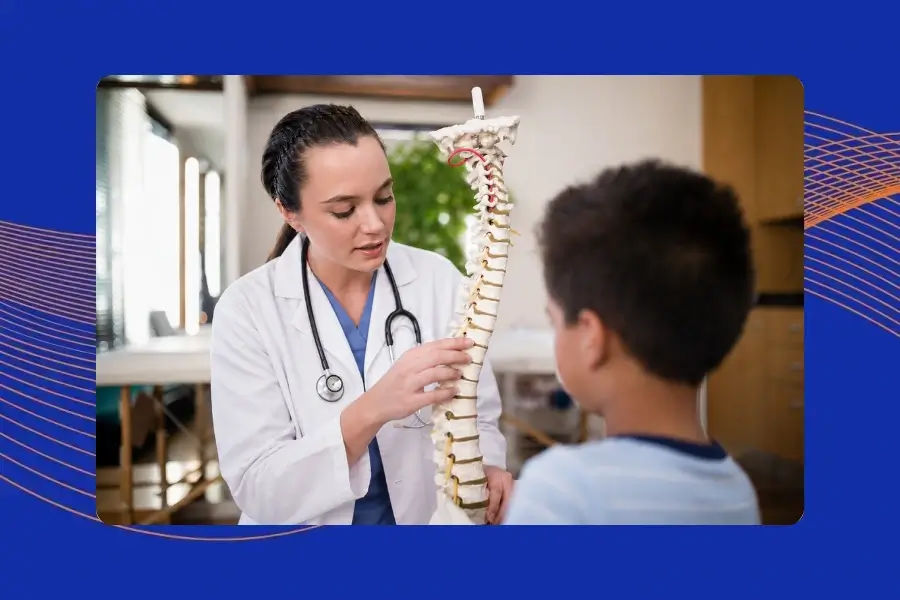
You have done the hard work of getting your child to this point. You saw the early warning signs of scoliosis symptoms, got the diagnosis, and made the decision to move forward with a pediatric scoliosis surgery. Now you need a clear picture of what recovery looks like: when your child goes back to school, when they can play their sport again, and what the next several months of daily life actually look like.
At the Advanced Spine Center in Morristown, New Jersey, Dr. Jason Lowenstein and his team perform scoliosis surgery for children and teenagers across three major approaches, spinal fusion, vertebral body tethering (VBT), and anterior scoliosis correction (ASC), among many other minimally invasive options. Scoliosis surgery recovery for children looks meaningfully different depending on which procedure your child has.
Pediatric Scoliosis Surgery Recovery Starts Before You Leave the Hospital
The first 24 to 48 hours of your child’s scoliosis surgery recovery are closely monitored as anesthesia clears and pain is managed through IV medication. Most children take their first assisted steps during these initial hours out of surgery.. Early movement is intentional, not rushed, to reduce the risk of complications and begin reestablishing the circulation and muscle engagement the spine needs to heal.
How long your child stays in the hospital depends on their specific scoliosis procedure. After spinal fusion, most children remain for 3-5 days. Vertebral Body Tethering (VBT) patients typically go home in 2-3 days, and Anterior Scoliosis Correction (ASC) patients go home in about 2-4 days. An important milestone in the first 24 to 48 hours of your child’s scoliosis surgery recovery is your child walking independently, managing pain with oral medication, and meeting basic mobility goals.
Weeks 1 & 2 Of Your Child’s Scoliosis Surgery Recovery
The first 2 weeks at home are the most physically and emotionally demanding part of pediatric scoliosis surgery recovery. Understanding what to expect makes them more manageable.
Your child’s body is doing significant healing work, and fatigue is normal and expected. Pain management typically involves a short course of prescription medication transitioning to over-the-counter options within, with most surgeons targeting a wean off narcotics by week 2.
Activity follows the BLT protocol: no bending, no lifting, no twisting. These restrictions protect the fusion or tethering site during its most vulnerable window. Your child will learn to log-roll out of bed, avoid reaching overhead, and sit in supported positions. Most children can shower 48 hours after discharge.
Weeks 3 -4 Of Your Child’s Scoliosis Surgery Recovery
Returning to school after scoliosis surgery is one of the milestones families plan around most. The timeline varies by procedure and situation.
After spinal fusion for scoliosis, most children return to school 4 weeks post-op, typically beginning with half-days. After VBT or ASC, many children are back in school within 2-4 weeks, sometimes sooner. Backpack restrictions may be in place.
Before your child returns to school after a scoliosis surgery, the school may need documentation. The Advance Spine Center Team patient advocate team can provide a surgeon’s letter outlining physical restrictions, PE exemptions, and any accommodations required.
Months 1-3 Of Your Child’s Scoliosis Surgery Recovery
This is the phase where the difference between procedures becomes most significant.
After your child’s spinal fusion for scoliosis correction, light activity such as walking and easy movement is encouraged from week 1 but it’s around the 3-month mark that most children are cleared for recreational activity, including casual swimming and gentle cycling. Competitive sports and contact activities remain restricted until the 6-month clearance.
After a VBT procedure for adolescent scoliosis correction, your child’s recovery compresses considerably. Most VBT patients are cleared to return to sports and activities within 4-6 weeks following their spine surgery. Because VBT preserves spinal motion rather than locking segments into fusion, the spine heals without the extended immobility that fusion requires.
After ASC, the recovery profile is similar to VBT. Motion is preserved, and most patients are cleared for sports within 3-4 months.
Physical therapy typically begins in earnest during this period, focused on core strength, flexibility, and restoring movement patterns. Compliance with physical therapy in recovery from a pediatrics scoliosis surgery is one of the factors that most reliably predicts how well and how quickly children regain their activity level.
Beyond 3 Months & Long-Term Adolescent Scoliosis Surgery Recovery
Most families are thinking further ahead than the first six weeks of recovery. Will the child’s life after scoliosis surgery at 1 year, at 5 years be meaningfully better than before the procedure.
Many children gain 1-2 inches of height after successful curve correction, a result of the spine lengthening as the curve straightens. Visible posture improvement is typically apparent within weeks and continues refining over the following 12 months. Most children and teenagers emerge from pediatric scoliosis surgery with less pain, a curve that will not continue progressing, and the ability to return to the activities they care about.
For children who had spinal fusion, some reduction in flexibility in the fused segments is permanent. For most daily activities, including sports, this is not functionally limiting. For VBT and ASC patients, spinal motion is preserved, which carries implications for long-term disc health as well as active life.
After VBT specifically, the tether continues working as the child grows, meaning the correction can continue improving over time. Follow-up imaging is scheduled every 6 months until skeletal maturity to track this progress.
Not Sure If Your Child’s Scoliosis Surgery Recovery Is On Track?
Most of what your child experiences in the first weeks of scoliosis survey recovery is fatigue, soreness, mood fluctuations, disrupted sleep. There are signs you can look out for that warrant a call to The Advanced Spine Center in Morristown, Bridgewater, and Rockaway, such as:
- fever above 101°F
- increasing redness or discharge at the incision site
- pain that worsens rather than gradually improves
- any new numbness or tingling in your child’s legs or feet
Follow-up visits are typically scheduled at 2 weeks, 6 weeks, 3months, 6 months, and 12 months, but be sure to follow the specific instructions and guidelines from your scoliosis surgeon in New Jersey as they will be customized to your child’ s unique situation.
Exhausted Conservative Steps In your Child’s Scoliosis Care Plan?
If your child’s scoliosis curve has progressed despite consistent bracing, if conservative treatment has stopped being effective, or if the curve was simply too severe for non-surgical options from the start, a scoliosis surgery consultation may be the right next step. The decision to move forward is not one any family takes lightly, and should be made with the help of the right scoliosis specialist. Dr. Lowenstein and the team at the Advanced Spine Center, with locations in Morristown, NJ, Bridgewater, NJ, and Rockaway, NJ, have dedicated their practice to exactly this moment in a child’s life. To schedule a consultation for your child’s scoliosis surgery, request an appointment today!