
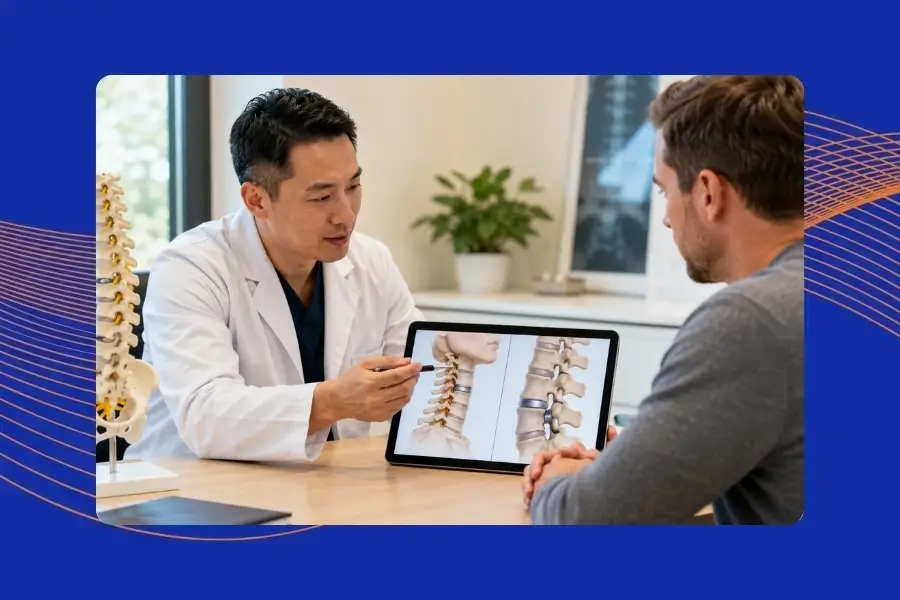
Cervical and lumbar artificial disc replacement both remove a worn disc and replace it with a motion preserving implant, but the neck and the lower back put very different demands on that device. A cervical disc is small and built for turning your head, while a lumbar disc is larger and carries your body weight with every step. That difference changes the surgical approach, who qualifies, and how recovery feels. At The Advanced Spine Center in Morristown, Bridgewater, and Rockaway, New Jersey, fellowship-trained and board-certified disc replacement specialist Dr. George S. Naseef plans each procedure around the level being treated.
What’s the Difference Between Cervical and Lumbar Artificial Disc Replacement?
Cervical artificial disc replacement treats a worn disc in the neck, reached through the front of the neck, using a small implant built for range of motion. Lumbar artificial disc replacement treats a worn disc in the lower back, usually reached through the front of the abdomen, using a larger implant built to bear weight. Same idea, different anatomy, different demands on the device.
The implant maker matters too. A device such as the ProDisc® line is sized and shaped for its region, so the artificial disc chosen for a neck is not the same as one chosen for a lower back
How Does Cervical Artificial Disc Replacement Work?
Cervical artificial disc replacement reaches the damaged disc through a small incision at the front of the neck. Using minimally invasive techniques, Dr. Naseef moves the soft tissue aside instead of cutting through muscle to remove the worn disc to set the implant in place. That front of neck route is a large reason many patients have little muscle soreness and go home the same day or the next. A smaller incision with a gentle technique can yield a more comfortable ADR recovery.
Motion preservation is the goal of a cervical ADR at our spine clinics in New Jersey. In a systematic review of two FDA cervical disc trials, adjacent segment disease stayed lower after disc replacement than after fusion at five years, 2.9 percent versus 4.9 percent, while the treated level kept moving normally.
How Does Lumbar Artificial Disc Replacement Work?
Lumbar artificial disc replacement reaches the lower back disc from the front of the abdomen, so the large back muscles are moved aside rather than cut to achieve a minimally invasive approach. Working from the front means planning around the organs and blood vessels that sit in front of the lower spine. The implant here has a harder job, because it supports far more load every time you stand, walk, bend, or lift, which is why a device, such as ProDisc, is built to take that weight.
Outcomes in patients hold up over time. A systematic review of lumbar disc replacement reported patient satisfaction between 75 and 93 percent at mid to long term follow up. Because the small facet joints behind the disc guide how the lower back moves, Dr. Naseef confirms those joints are healthy before recommending a lumbar implant.
Candidacy for Cervical or Lumbar Artificial Disc Replacement in New Jersey
A candidate for either cervical or lumbar disc replacement in Morristown, Bridgewater, and Rockaway, New Jersey usually has disc disease at one or two levels, symptoms that match the damaged disc on imaging, and several months of nonsurgical care that did not bring lasting relief. Bone quality, alignment, and stability are also taken into consideration for ADR candidacy.
Before recommending either ADR procedure, Dr. Naseef confirms:
- The damaged disc matches your pain and symptoms
- Only one or two levels are involved
- The facet joints, bone strength, and alignment can support an implant
- The spine is stable at that level
When more than a couple of levels are worn, when the facet joints are arthritic, or when the spine is unstable, a fusion such as anterior cervical discectomy and fusion could be a better fit.
Recovery for Neck vs. Lower Back Disc Replacement
Recovery for a neck disc replacement vs a low back disc replacement differs mostly because of where the incision sits and how much load the area carries. After a neck ADR, soreness centers on the front of the neck, and some people notice short lived throat irritation or trouble swallowing that eases within a few days. After a lower back ADR, soreness settles around the abdomen and lower back, and rebuilding activity is paced because standing and walking send load straight through the lumbar spine.
Both procedures keep the spine moving, which is the whole point for people who want to get back to golf, hiking, or playing with their kids without the limits of a fusion.
How do you decide which disc replacement is right for you?
The level on your MRI, whether it reads C5 to C6 or L4 to L5, is where the decision starts rather than where it ends. A neck finding raises questions about nerve or spinal cord pressure and whether the level stays stable once an implant is in place. A lower back finding raises a harder one first, whether the disc is truly the source of your pain, since the facet joints and nearby structures often share the blame. What surrounds the level, the nerves, the facet joints, the bone, and the alignment, decides whether an artificial disc is the right call and whether it belongs in your neck or your lower back.
| ADR Decision Factors | Cervical (Neck) | Lumbar (Lower Back) |
| Location of the damaged disc | Neck, which holds up and turns your head | Lower back, which carries your body weight |
| Spine surgeon confirms | A nerve or the spinal cord is compressed and matches your symptoms | The disc itself is the pain source, not the facet joints |
| What can rule out an ADR | An unstable level, or one that no longer moves | Arthritic facet joints or an unstable segment |
| Main alternative if ADR isn’t a fit | Anterior cervical discectomy and fusion | Lumbar spinal fusion |
You do not have to figure out whether an artificial disc is the answer on your own. Dr. Naseef and the team at The Advanced Spine Center will review your imaging, your symptoms, and what you have already tried, then tell you honestly whether cervical or lumbar disc replacement is right for you, or whether another approach would serve you better.
Request an appointment with Dr. Naseef in Morristown, Bridgewater, and Rockaway, New Jersey, and find out whether artificial disc replacement is right for you.