
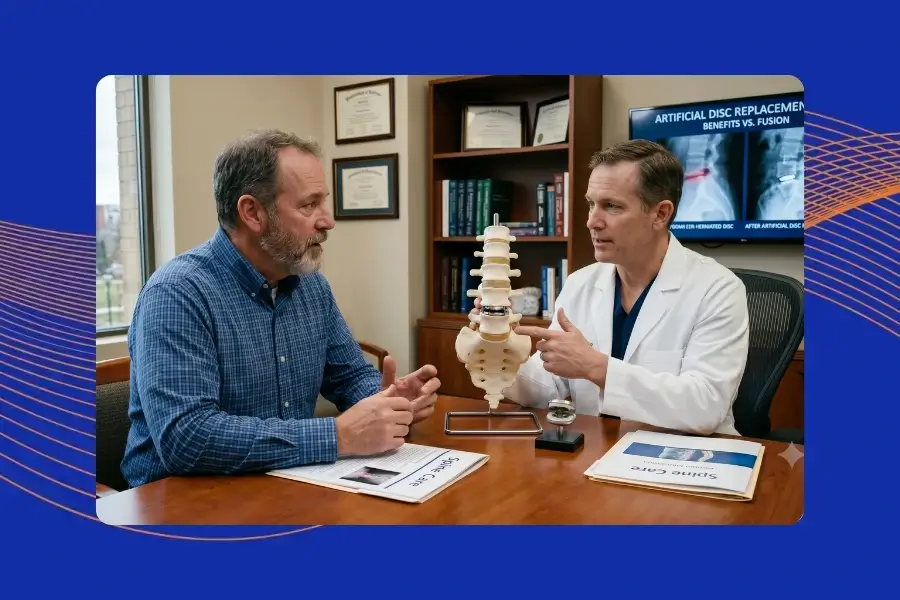
If you have been told that more than one disc in your spine is damaged or degenerating, you are probably wondering what your options are. For many patients, the default answer they hear is spinal fusion. But for the right candidates, artificial disc replacement (ADR) is a motion-preserving alternative that can be performed at more than one level.
Here is what patients across New Jersey and the New York metro area need to know about multi level disc replacement and whether it might be right for you.
What Is Multi-Level Disc Disease?
Your spine is made up of vertebrae separated by discs that act as cushions and allow movement. When those discs break down, a common result is a spine condition called degenerative disc disease, or DDD. In some patients, this disc degeneration does not stop at one level. It progresses to affect two or more adjacent levels of the spine, commonly referred to as multi-level disc disease. Symptoms of multi-level degenerative disc disease often include chronic neck or back pain, stiffness, reduced range of motion, and radiating pain, numbness, or tingling into the arms or legs depending on where the affected levels sit.
The challenge with multi-level disc disease is that treatment decisions become more complex. More levels affected means more to address, and the approach matters a great deal for your long-term spine health.
Can Artificial Disc Replacement Be Performed at More Than One Level?
Yes. Two level cervical disc replacement and lumbar disc replacement are FDA-approved and have been performed successfully in appropriately selected patients. The same motion-preserving principles that apply to single-level ADR extend to two-level cases, with some important nuances.
When you fuse two levels of the spine, you permanently eliminate movement at both of those segments. That lost motion transfers stress to the discs above and below the fusion, accelerating degeneration at those adjacent levels over time. Multi level disc replacement avoids this by preserving natural movement at both treated levels, reducing the mechanical burden on the rest of your spine.
For patients who are 2 level disc replacement candidates, this can mean a more natural recovery, better long-term spinal function, and a lower risk of needing additional surgery down the road.
Who Is a Candidate for Multi-Level ADR?
Multi-level artificial disc replacement requires careful patient selection. The criteria are more specific than for single-level artificial disc replacement surgery, and meeting them across two levels simultaneously raises the bar further.
ADR candidates typically need adequate disc height remaining at both affected levels, good bone quality, and proper spinal alignment. Patients with significant facet joint arthritis, severe instability, or prior fusion surgery at an adjacent level may not be suitable. Age, overall health, and the specific location of the affected levels also factor into the decision.
Two level disc replacement is not a one-size-fits-all solution. Some patients with disease at two levels are better served by a hybrid approach, combining ADR at one level with fusion at another, depending on the condition of each individual disc and surrounding anatomy. Others may qualify for full 2 level disc replacement at both levels. The only way to know is through a thorough clinical evaluation including imaging review with an ADR specialist and surgeon like Dr. Naseef in New Jersey, who specializes in disc conditions.
What to Expect During Multi-level Artificial Disc Replacement Recovery
Recovery after two level disc replacement follows a similar path to single-level ADR but with a modest extension in timeline. Most patients can expect:
- Same-day or 23-hour hospital stay depending on procedure type
- Return to desk work within 2-3 weeks for most patients
- Physical therapy beginning around week 4-6, with a focus on restoring range of motion and rebuilding strength across both treated segments
- Return to full activity including sport, golf, and playing with your kids by 3-4 months pending surgical clearance
Compliance with physician therapy is particularly important after 2 level artificial disc replacement because the surrounding musculature needs to adapt to movement being preserved at two levels rather than one.
Why Surgeon Experience Matters for Multi-level Artificial Disc Replacement
Single-level disc replacement is technically demanding. Multi level disc replacement is more so. The precision required to place an implant correctly, preserve surrounding anatomy, and achieve proper alignment increases with every additional level treated.
Dr. George S. Naseef is The Advanced Spine Center‘s fellowship-trained, board-certified disc replacement specialist with over 19 years of experience in motion-preserving spine surgery. He sees patients at our Bridgewater, Morristown, and Rockaway, NJ locations, and has evaluated and treated patients with multi level cervical disc replacement needs from across New Jersey, including Somerset, Morris, and Union counties, as well as patients traveling from across the United States. His approach to multi-level cases begins with an honest assessment of whether ADR is truly the right solution for each individual patient.
Every patient deserves an expert evaluation from a spine surgeon who knows both what is possible and what is best for their spine long term.
Find Out If You Are a Candidate For Multi-level Artificial Disc Replacement in Bridgewater, Morristown, or Rockaway, NJ
If you have been diagnosed with disc disease at more than one level and want to understand whether artificial disc replacement is an option, the next step is a consultation with a spine and disc pain specialist.
Take our 3-Minute Disc Replacement Quiz to get started, or request an appointment with Dr. Naseef today.