
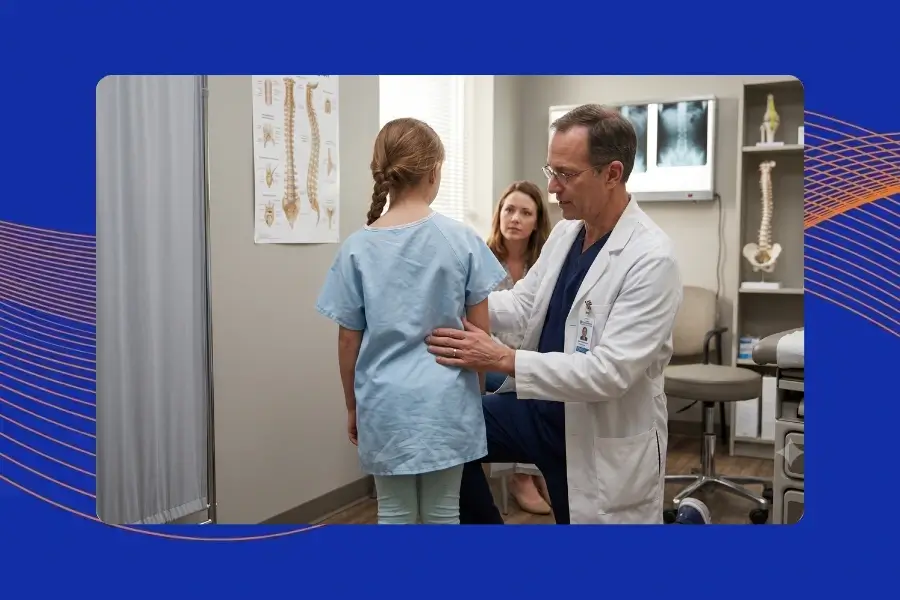
A scoliosis diagnosis, or even a flag at a school screening, tends to catch parents off guard. But for most families, it is the beginning of a manageable process, not a crisis. Scoliosis in growing children is one of the most common spinal conditions we treat, and the overwhelming majority of children who are diagnosed and monitored appropriately go on to live full, active lives without significant limitations. The most important thing you can do right now is exactly what you are doing: learning about it early.
The First Signs of Scoliosis in Growing Children
Childhood scoliosis symptoms are often subtle, which is part of why school screenings catch so many cases. Unlike adult scoliosis, which frequently involves back pain, scoliosis in children and teens is usually painless. What you notice is asymmetry, something that looks slightly uneven.
The first signs of scoliosis parents most often catch include:
- One shoulder sitting higher than the other
- A shoulder blade that sticks out more on one side
- A waist that looks uneven when the child is standing
- A slight lean to one side
During the school screening, a nurse or doctor uses something called the Adam’s forward bend test where the child bends forward at the waist with arms hanging loose, and a visible curve or rib prominence becomes apparent from behind. A positive result on that test does not mean your child has a serious problem. It means the curve is worth a closer look.
How Scoliosis Can Change During the Growing Years
The honest answer is that it depends on the curve size and, crucially, how much growing your child has left to do. Scoliosis in growing children and skeletal growth are directly connected. The years when a child is growing fastest, roughly ages 10 to 14 for girls and 12 to 16 for boys, are also the years when a curve has the greatest potential to progress. Once growth slows and the skeleton matures, the curve generally stabilizes.
Scoliosis specialists, like our very own Dr. Lowenstein – board certified, fellowship-trained, adult and pediatric Spine and Scoliosis Surgeon in Morristown, NJ, uses a bone maturity assessment to estimate how much growth a child has remaining, which directly shapes how closely a curve needs to be watched. A small curve in a child still years away from skeletal maturity is monitored carefully. A larger curve in that same child calls for more active management. Your child’s scoliosis specialist in Morristown, NJ will factor in their individual growth stage and curve behavior, but generally these clinical guidelines can be followed:
| Curve Size (Cobb Angle) | Typical Approach |
| Under 20 degrees | Observation with regular imaging |
| 25 to 40 degrees | Bracing (in growing children) |
| 45 degrees or more | Surgical consultation |
Treatment Options for Growing Children With Scoliosis
The treatment options available for growing children with diagnosed scoliosis in New Jersey follow their curve, age, and how much growing they have left. There is no one-size answer, and most families move through this gradually rather than facing a single big decision all at once.
For smaller scoliosis curves in growing children, the first step is often simply watching carefully. Regular imaging every few months to track whether anything is changing. This is not passive. It is active monitoring, and it keeps your child’s care responsive to what is actually happening.
For moderate curves in children who are still growing, scoliosis bracing is a common non-surgical option. A scoliosis brace does not straighten the spine. Its job is to prevent the curve from progressing further during the growth years.
A landmark clinical trial published in the New England Journal of Medicine found that 72% of adolescents who braced consistently avoided curve progression to the point of needing surgery, compared to 48% in those who were only observed.
When a curve is larger or has progressed despite bracing, surgery becomes the conversation. Traditional spinal fusion stabilizes the spine effectively but reduces some motion. A newer approach called Anterior Scoliosis Correction (ASC) is less invasive, performed through the side of the body, and preserves more spinal motion, making it particularly well-suited for adolescent patients whose active years are just beginning.
When Is Surgery the Right Step for a Growing Child With Scoliosis
A scoliosis surgery for a growing child is generally considered when a spinal curve reaches 45 to 50 degrees in a child who is still growing, or when a curve has continued progressing despite bracing. The best age for scoliosis surgery, when it is needed, is generally while the patient is still young enough to achieve the best correction. Earlier intervention often means better outcomes and faster recovery, particularly with motion-preserving techniques like Anterior Scoliosis Correction.
For very young children with severe curves, surgeons sometimes use growing rod techniques that stabilize the spine while allowing it to continue developing, a specialized approach that delays permanent correction until the child is older.
The most important thing to know is this: the decision is never made lightly, and a good scoliosis surgeon and specialist will walk through every factor with you.
Why Seeing a Pediatric Scoliosis Specialist Matters
Pediatric scoliosis requires a different kind of expertise than adult spine care. Growing spines behave differently, the timing of intervention matters in ways it does not for adults, and the surgical techniques appropriate for a teenager are not the same as those for a 50-year-old.
At The Advanced Spine Center, we specialize in pediatric and adolescent scoliosis across our New Jersey locations in Bridgewater, Morristown, and Rockaway, New Jersey. We follow patients through the full continuum of care, from a small curve caught at a school screening to bracing, surgical correction, and recovery. If you are not sure where your child stands, our 2-Minute Scoliosis Quiz is a good starting point, or request an appointment to speak with our scoliosis expert, Dr. Lowenstein. You do not have to figure this out alone.