
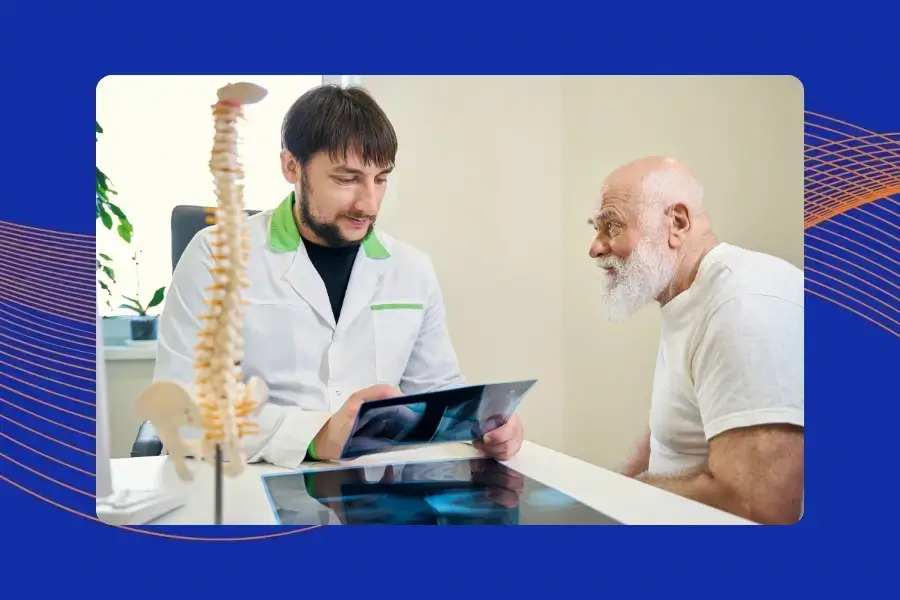
Modern artificial discs are designed to function for many years, with some implants expected to last 20 years or longer. However, there is no fixed expiration date, and how long an artificial disc lasts depends on the implant, the treated spine, surgical technique and the patient’s overall health.
Artificial disc replacement (ADR), also called total disc replacement or disc arthroplasty, is designed to relieve pain caused by a damaged spinal disc while preserving movement at the treated level.
Unlike spinal fusion, which permanently joins two vertebrae, ADR replaces the damaged disc with an implant designed to maintain movement in the neck or lower back. For candidates, it may provide durable pain relief, improved function and a return to many everyday activities.
Modern artificial discs are built for long-term use, but their performance varies from person to person. The treated area of the spine, implant type, surgical technique, bone health, activity level and overall health can all influence the outcome.
What Is the Expected Lifespan of an Artificial Disc?
Rather than having a set replacement date, an artificial disc is designed to stay in place and function over the long term. Many people never need their implant replaced. Long-term studies of cervical disc replacement have also reported continued pain relief, improved function and preserved movement at follow-ups of seven years, 10 years and beyond.
That said, no implant’s lifespan can be predicted exactly. Over time, factors such as device wear, bone growth around the implant, changes in nearby spinal levels and your overall spine health may affect how well it continues to move and relieve symptoms.
If concerns develop, your spinal surgeon can check the implant and surrounding spine through follow-up appointments and imaging.
Factors that can affect artificial disc replacement longevity include:
- The condition of the spine before surgery
- The number and location of treated levels
- Bone quality and spinal anatomy
- Implant positioning and surgical technique
- Smoking, weight and overall health
- Wear, degeneration or changes at the treated or nearby levels
- Following post-operative instructions and activity guidance
The important point is that artificial disc replacement longevity is not determined by the implant alone. The health of the surrounding spine matters too.
Our spine specialists can provide a more realistic expectation based on your diagnosis, imaging and the specific implant being considered.
Long-Term Outcomes of ADR Surgery
For carefully selected patients, ADR can provide lasting improvements in pain, function and quality of life. One of its main advantages is the preservation of movement at the treated spinal level.
That matters because fusion eliminates movement at the fused segment. ADR is designed to maintain it.
Long-term cervical disc arthroplasty research has found sustained clinical benefits in selected patients. Some studies report fewer secondary surgeries and lower rates of symptomatic adjacent-level disease than fusion, although results vary by device, study, and patient population.
Lumbar ADR has also demonstrated motion-preserving benefits in appropriately selected patients. However, lumbar disc replacement is not suitable for every type of lower back pain. Long-term lumbar ADR evidence is more limited and varies by implant and patient selection. In one five-year study comparing two-level lumbar disc replacement with fusion, 9.6% of all participants underwent secondary surgery; the rate was lower in the disc-replacement group than in the fusion group (5.6% versus 19.1%).
Artificial Disc Replacement vs. Fusion
Both ADR and spinal fusion can be effective. The better choice depends on the condition being treated, the spinal level involved, spinal stability, facet joint health, bone quality and other clinical factors.
| Consideration | Artificial Disc Replacement | Spinal Fusion |
| Primary goal | Replace the damaged disc while preserving movement | Stabilise the spinal segment by joining the vertebrae |
| Motion at treated level | Designed to preserve movement | Movement is eliminated at the fused level |
| Typical candidate | Selected patients with disc disease and suitable spinal anatomy | Patients with instability, deformity, advanced degeneration or other conditions where fusion is appropriate |
| Long term considerations | Implant wear, bone changes and future treatment remain possible | Adjacent level changes and future treatment remain possible |
For cervical procedures, ADR has become an established alternative to anterior cervical discectomy and fusion (ACDF) for selected patients.
Neither option is automatically the better choice. The right procedure depends on what is happening in the individual spine.
What Can Affect ADR Longevity?
The goal after ADR surgery is not simply to protect the implant. It is to support the health of the spine as a whole. Following the surgical team’s recommendations can help support a good long-term outcome. This may include:
- Attending recommended follow-up appointments and imaging
- Returning to work, exercise and sports according to surgical guidance
- Maintaining a healthy weight and appropriate activity level
- Avoiding smoking or nicotine use
- Reporting new or recurring neck, back, arm or leg symptoms
- Completing rehabilitation or physical therapy when recommended
For example, returning to high-impact activity too quickly may not be appropriate immediately after surgery, even if pain has already improved. Your recovery plan should be based on the procedure performed and your individual progress.
A well-functioning implant also does not prevent future spine problems. Degeneration can still develop at other levels, and some patients may eventually require additional treatment.
Are There Risks or Reasons for Revision Surgery?
For appropriately qualified candidates, artificial disc replacement can offer a motion-preserving alternative to fusion, with the potential for lasting pain relief and improved function. As with any spine procedure, outcomes depend on individual anatomy, the condition being treated and careful surgical planning.
Your surgeon will assess whether ADR is suitable for you, select and position the implant appropriately, and provide follow-up care to support recovery and monitor your progress. Most people hope to return to comfortable movement and everyday activities, while understanding that some symptoms may continue and further treatment may occasionally be needed.
During the consent process, your surgeon may discuss potential issues such as persistent or recurring symptoms, bone formation around the implant that can reduce movement, implant positioning or wear concerns, and degenerative changes at other spinal levels. These are not expected outcomes for everyone, but they are important considerations when comparing ADR with other treatment options.
Long-term research supports favourable outcomes for carefully selected cervical ADR candidates. Studies have reported lasting clinical improvement, preserved motion and relatively low rates of additional surgery over extended follow-up.
Cervical vs. Lumbar Disc Replacement Outcomes
Cervical and lumbar ADR are different procedures used to treat different spinal conditions.
Cervical disc replacement is generally used for selected cases of cervical disc disease causing symptoms such as neck pain, arm pain, numbness, weakness or nerve compression. Lumbar disc replacement may be considered for selected patients with disc-related lower back pain.
Recovery, candidacy requirements and expected outcomes can vary significantly between the two procedures.
Discuss Your ADR Options
Artificial disc replacement can be a durable, motion-preserving option for appropriately selected people with disc-related neck or back pain. The best way to understand how long an artificial disc may last and what outcomes you might reasonably expect is through an individual evaluation that considers your diagnosis, imaging, symptoms and goals.
If you are considering ADR, a spine specialist can look at your scans, symptoms and overall spine health to help you understand whether it is suitable and what you can realistically expect. Contact The Advanced Spine Center in New Jersey to discuss your options and next steps.