
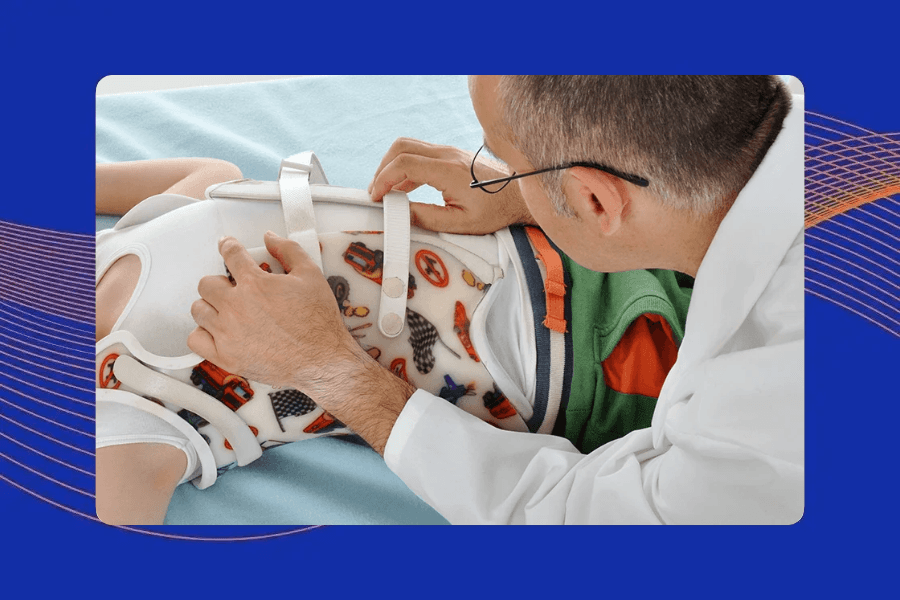
Scoliosis Bracing (also called orthotics) remains a valid and widely used treatment option for children and teenagers with spinal deformity. Although doctors have used bracing as a scoliosis intervention for centuries, modern advances in orthotic materials have enabled spine specialists to help slow or halt the progression of abnormal curvature.
However, scoliosis bracing is generally intended to help slow or prevent further curve progression rather than fully correct the curve. To accomplish this, an individual would typically require surgery. Instead, orthopedists use bracing as a preventative measure to impede further progression of sideways curvature. This is why bracing is especially crucial during childhood and adolescence. In particular, the growth spurt that follows the onset of puberty often marks a sudden worsening of scoliosis symptoms. Praised for its effectiveness, minimally invasive braces allow scoliosis sufferers to moderate changes in spinal curvature.
For many families, early detection is important because the best time for scoliosis bracing is often while a child or teenager is still growing. A spine specialist can assess the curve, growth stage, and individual treatment needs before recommending a brace.
How Do I Know If I Need Scoliosis Bracing?
A spine specialist may recommend a scoliosis brace for a child or teenager with a curve of approximately 20–50 degrees who is still growing. Children with curves below this range may be monitored over time, depending on their growth stage and risk of progression. However, your doctor will only prescribe orthotics if he/she determines that your spinal curvature will continue to advance rapidly. Doctors usually consider progression to be “rapid” if the curvature advances at least 5-10 degrees over a 6-month period.
The ideal age for scoliosis bracing depends less on a specific number and more on how much growth remains. Bracing is generally most effective when a child or teenager has significant growth remaining and the curve is at risk of progressing.
When researching your bracing options, you will most likely find yourself reading a slew of city names. Boston, Charleston, Milwaukee… It can sound like you’re planning a cross-country road trip! All things considered, don’t let these names confuse you. Scoliosis braces are typically named for the city in which they were developed or for the individual who invented them. Names aside, the most important factor lies in the function of the specific brace. However, you will find subtle differences in the placement of the brace, the mechanics of the design, and the targeted portion of the spine.
The most prevalent spinal disorder in adolescence, scoliosis affects up to 5% of the pediatric population. And, of the many different categories of scoliosis, a majority of adolescent cases boast unknown, or idiopathic, sources. However, state-of-the-art advances in orthotics provide a noninvasive form of treatment for many teenagers and younger children.
Common Types of Scoliosis Braces
Boston Brace: One of the most widely used designs in the U.S., the Boston Brace takes advantage of the rigid brace style. Specifically, this design employs a Thoraco-Lumbo-Sacral-Orthosis design, beginning at the pelvis and ending at the base of the shoulder blades. In particular, doctors use this design to halt abnormal curvature in the lumbar or lower thoracic spine. Traditional Boston Brace models are prefabricated to fit most bodies, allowing for a streamlined ordering process. Furthermore, the more specialized Boston Brace 3D is contoured to the individual, constructed from a mold of your own body.
Milwaukee Brace: Similar in construction to the Boston Brace, the Milwaukee Brace covers a slightly different segment of the individual’s torso. Also called a Cervico-Thoraco-Lumbo-Sacral-Orthosis (or CTLSO) brace, the Milwaukee Brace extends from the pelvis to the base of the skull. This allows for inclusion of the cervical spine in bracing and addresses scoliotic curves that sit higher on the spine.
Charleston Bending Brace: With its flexible design, the Charleston Bending Brace allows individuals to sleep comfortably at night. Clinicians were encountering issues with patient compliance, as patients complained that rigid braces were uncomfortable, visible under clothing, and restrictive. The Charleston option, designed for curves of 25-35 degrees, fits much like a Boston Brace. However, the brace itself uses a more comfortable, malleable material than traditional plastic orthotics.
ScoliSMART™ Activity Suit: Abnormal firing of the back muscles can cause certain types of scoliosis. Therefore, the primary objective of the ScoliSMART™ Activity Suit purposes to retrain the surrounding muscles of the spine, instead of simply pulling on the spine itself.
Choosing the Best Scoliosis Brace for Your Child
We have listed three traditional options and one up-and-coming alternative to treat adolescent scoliosis in the options detailed above. Keep in mind, however, that your doctor may recommend additional models. Other bracing approaches include the Chêneau model, the Wilmington brace, the Providence brace, plus more! (The list of choices goes on and on!)
There is no single best scoliosis brace for every child or teenager. The most appropriate option depends on the location and size of the curve, the child’s age and stage of growth, comfort and ability to wear the brace consistently, and the specialist’s assessment.
If your child needs scoliosis bracing, the right design should be selected based on their individual curve and growth stage, not the brace’s name or popularity. Although bracing may help slow or prevent further curve progression, it does not correct every curve or eliminate the need for other treatment in every case. To discuss scoliosis bracing and other treatment options for your child, contact The Advanced Spine Center to schedule an appointment in New Jersey.
Updated September 2026.